

THE GREAT DECAY AND THE END OF AN ERA
The Great Decay is a five-track EP by Disabled Parker, running just under 24 minutes before its physical-exclusive bonus track. Although relatively short, the release represents something much larger for the band: the closing of the Gradual Unmaking era, the long-running period of Disabled Parker's history named directly after the album The Gradual Unmaking.
That album became the center of a much larger era. Its sound, imagery, themes, releases, physical editions, and overall identity continued expanding long after the album itself was finished. For a long time, The Gradual Unmaking was not simply one record in the Disabled Parker catalog. It became the defining project surrounding everything happening at the time.
Because of that, finally reaching the end of the Gradual Unmaking era is bittersweet.
The Great Decay serves as its final release.
At the same time, it is not necessarily the beginning of another era.
It exists somewhere in between.
TRACKLIST
1. Birth — 0:37
2. What Are You Waiting For? — 4:23
3. Inter 9 — 1:43
4. Dull — 6:25
5. Where All the Werewolves Are — 10:39
BIRTH
“Birth” is exactly what its title suggests: the beginning.
At only 37 seconds long, it contains little to no dialogue and acts primarily as an introduction to “What Are You Waiting For?” Rather than existing as a full song on its own, it establishes the atmosphere of the EP and leads directly into what follows.
WHAT ARE YOU WAITING FOR?
“What Are You Waiting For?” deals with drugs, manipulation, peer pressure, addiction, and the moment where curiosity turns into dependency.
The song approaches drug use from the perspective of someone being encouraged and pressured into it. Once they finally give in, the situation begins changing almost immediately. What initially seems like a choice becomes something they feel unable to control.
As the lyrics put it:
You fed into it.
Now you're hooked to it.
You cannot stop yourself.
All you had to do was say no.
It is one of the most direct songs on The Great Decay, built around the idea that a single decision can eventually become something much larger than the person making it ever expected.
INTER 9
“Inter 9” is a psychedelic instrumental interlude constructed with reversed audio, strange textures, and deliberately disorienting sounds.
There are no traditional lyrics or narrative explanations. Instead, the track acts as a transition deeper into the EP's atmosphere.
For approximately the final 40 seconds, the music gives way almost completely to static.
DULL
“Dull” is about feeling disconnected from yourself.
It is not necessarily about self-hatred. Instead, it describes the much stranger feeling of looking at yourself and not entirely understanding what you are looking at—feeling detached from normal emotion, detached from life around you, and almost disconnected from the idea of being a person at all.
It explores emotional emptiness without trying to turn that emptiness into something dramatic.
Sometimes there simply isn't much there.
WHERE ALL THE WEREWOLVES ARE
At 10 minutes and 39 seconds, “Where All the Werewolves Are” is by far the longest song on The Great Decay and serves as its closing track.
It is also intentionally difficult to explain.
The song functions almost like a memoir, pulling from memories and pieces of a life rather than following one simple narrative. Some parts of the song are deeply personal, and because of that, much of its meaning is deliberately left unexplained.
The title itself comes from an old childhood recording.
In the recording, a young Alexander Hunter is talking with his father about a train set. His father asks where the train is going.
The answer:
“Where all the werewolves are.”
There was no deeper meaning behind the sentence at the time. It was simply something a child said.
Years later, that tiny moment became the foundation for the title of a ten-minute song about memory.
“Where All the Werewolves Are” was also the final major piece added to the EP. After the first four tracks were completed, the project still felt too short to fully stand as an EP. Rather than adding several smaller songs, one much larger closing piece was created.
It eventually grew to nearly eleven minutes.
What originally began as a way to complete the runtime became the natural ending to The Great Decay.
THE PHYSICAL-ONLY BONUS TRACK
Physical editions of The Great Decay include an additional track:
“Burn”
The track is exclusive to the CD and cassette editions of the EP and is not included with the standard streaming release.
There is no streaming equivalent or digital bonus edition. The physical release itself is the only way the bonus track is included as part of The Great Decay.
THE NAME
The title The Great Decay originated with Aiden Shattuck.
The name immediately stuck.
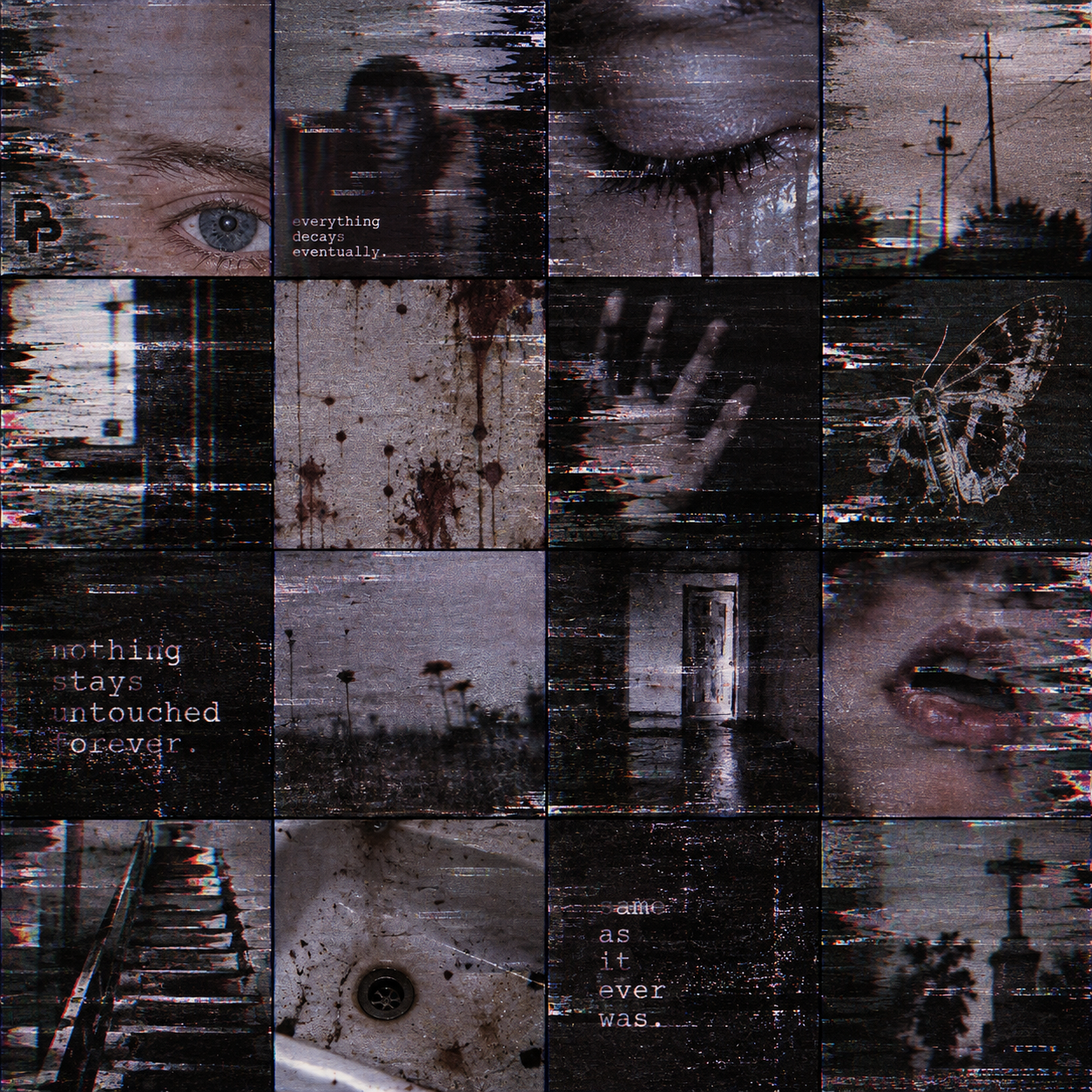
It captured what the EP was becoming visually and thematically: deterioration, change, emotional distance, memory, corruption, and the idea that almost nothing remains untouched forever.
The phrase eventually became inseparable from the project.
THE ARTWORK
The cover of The Great Decay began with an extremely simple image:
Alexander Hunter's eye.
The photograph was gradually altered with VHS-inspired distortion, digital corruption, grain, glitches, and damaged textures. Earlier versions of the artwork were relatively restrained, featuring primarily the eye and light visual distortion.
As the EP developed, the artwork continued deteriorating with it.
One of the final additions was the Disabled Parker DP logo in the lower-left corner. That small addition ended up completing the design and establishing the final version of the cover.
Despite how heavily manipulated the finished artwork appears, the eye at the center of it is real.
THE END OF THE GRADUAL UNMAKING ERA
The Gradual Unmaking era takes its name directly from Disabled Parker's album The Gradual Unmaking.
What started with that album eventually became something much larger than the record itself. The era expanded through its visual style, physical editions, alternate material, related releases, imagery, concepts, and the continuing identity surrounding Disabled Parker during that period.
For a long time, The Gradual Unmaking remained the center of the band's creative world.
That is what makes The Great Decay important.
It is not another chapter inside the Gradual Unmaking era.
It is the thing that closes it.
There is no massive declaration of what comes next. There is no immediate attempt to replace the identity that came before it.
The Great Decay simply allows that chapter to end.
Five tracks.
One final physical bonus track.
23 minutes and 47 seconds before the bonus track.
And the end of the Gradual Unmaking era.